What sole traders and landlords need to do, without the jargon. If your self-employment and property income is over £30,000, the way you report to HMRC changes on 6 April 2027, which is 140 days away.
Keep your records digitally. Send HMRC a short summary every three months. That’s Making Tax Digital.
Making Tax Digital for Income Tax (MTD) replaces doing everything once a year in your Self Assessment return.
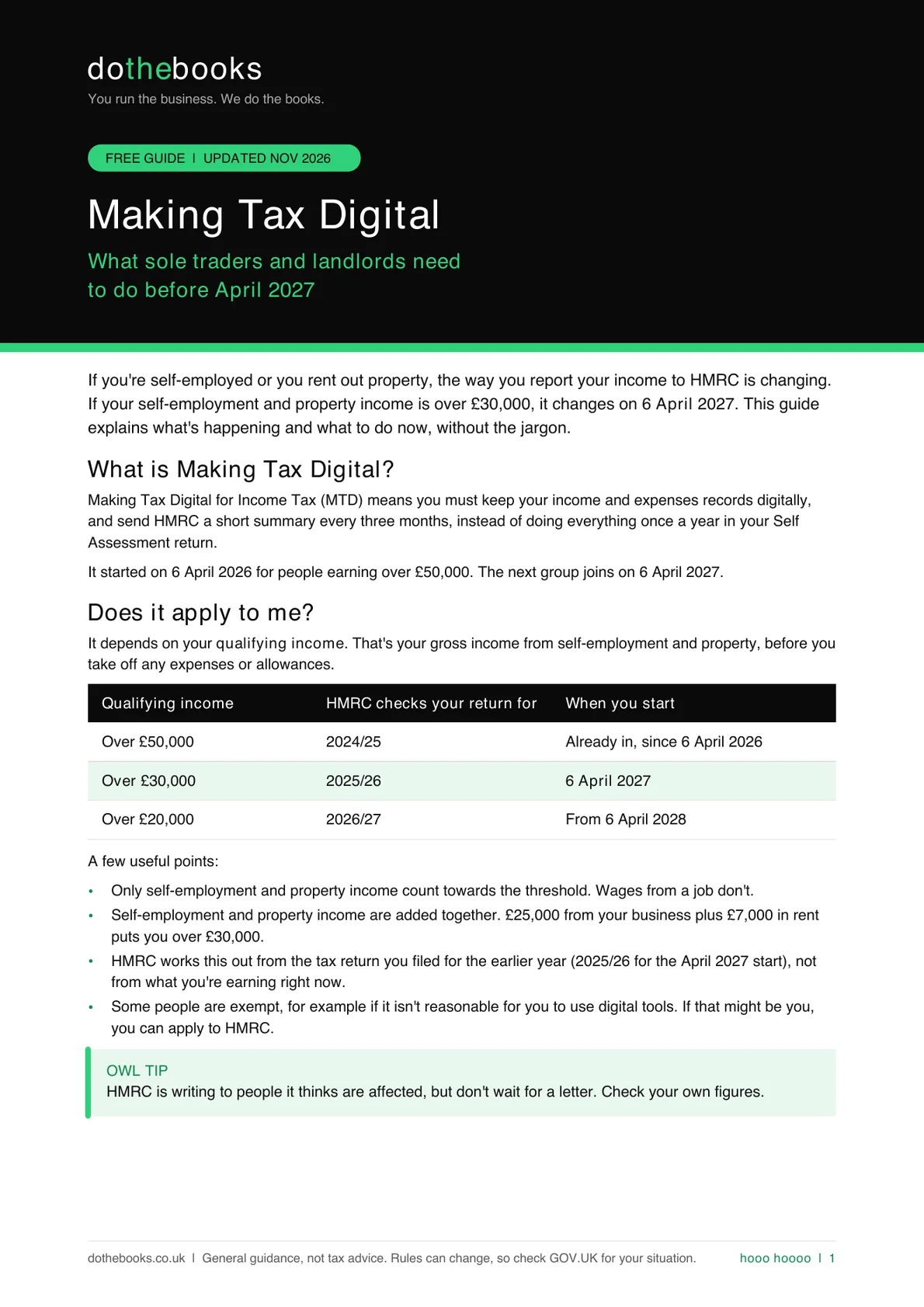
It started on 6 April 2026 for people earning over £50,000. The next group, over £30,000, joins on 6 April 2027.
It depends on your qualifying income: your gross income from self-employment and property, before you take off any expenses or allowances. Wages from a job don’t count.
Enter your figures to see when MTD reaches you.
Self-employment and property income are added together. HMRC checks the return you filed for the earlier year, not what you’re earning now.
Four things. None of them are hard once the habit is in place.
Every sale and expense, through the year. A notebook or a shoebox of receipts won’t do any more.
Accounting software, or a spreadsheet linked to HMRC through “bridging” software.
Short summaries of your income and expenses, sent to HMRC through that software.
After the year ends, confirm your full-year figures and file through your software by 31 January. HMRC calls it the “final declaration”.
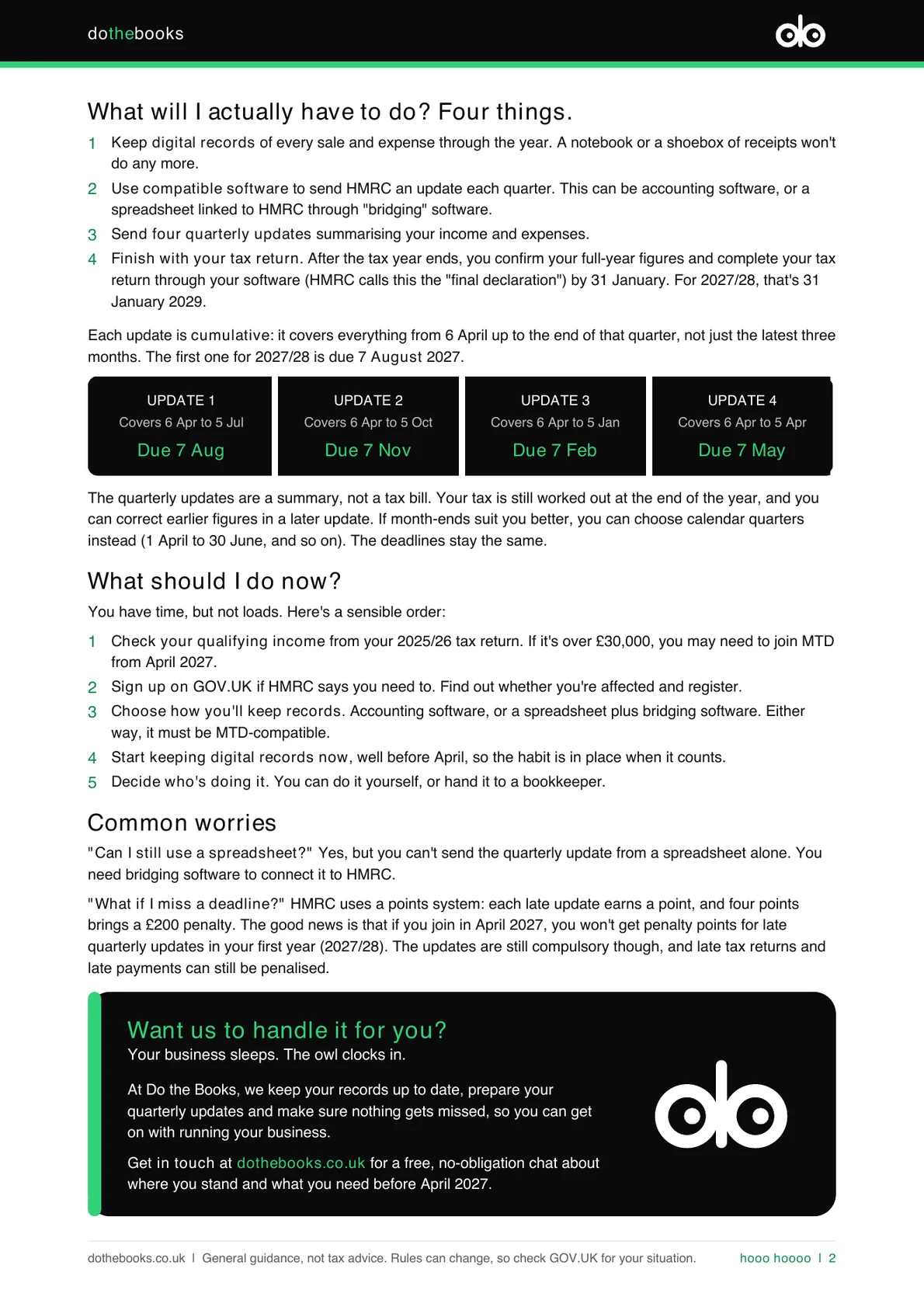
An update covers everything from 6 April to the end of that quarter, not just the latest three months. The first one for 2027/28 is due 7 August 2027.
A summary, not a tax bill.Your tax is still worked out at the end of the year, and you can correct earlier figures in a later update.
Prefer month-ends?You can choose calendar quarters instead (1 April to 30 June, and so on). The deadlines stay the same.
Then the tax return.Confirm your full-year figures and complete your return through your software. For 2027/28, that’s by 31 January 2029.
You have time, but not loads. Here’s a sensible order. Tick them off as you go; we’ll remember on this device.
Yes, but you can’t send the quarterly update from a spreadsheet alone. You need bridging software to connect it to HMRC.
HMRC uses a points system: each late update earns a point, and four points brings a £200 penalty. The good news is that if you join in April 2027, you won’t get penalty points for late quarterly updates in your first year (2027/28). The updates are still compulsory though, and late tax returns and late payments can still be penalised.
No. Only self-employment and property income count towards the threshold. They’re added together, so £25,000 from your business plus £7,000 in rent puts you over £30,000.
Some people are, for example if it isn’t reasonable for you to use digital tools. If that might be you, you can apply to HMRC.
Everything on this page in two printable pages. Keep it, share it, or hand it to whoever does your books.
Your download should start on its own. If it doesn’t, use the button.
Download the guide (PDF)Rather someone else did it? Talk to us about MTD
Your business sleeps. The owl clocks in.
We keep your records up to date, prepare your quarterly updates and make sure nothing gets missed, so you can get on with running your business. The first chat is free, with no obligation: where you stand, and what you need before April 2027.
Get startedOr call either of us.